

Omer Qureshi of Americans 4 Equality Publishes Four Questions for Testing Nonprofit Partnerships
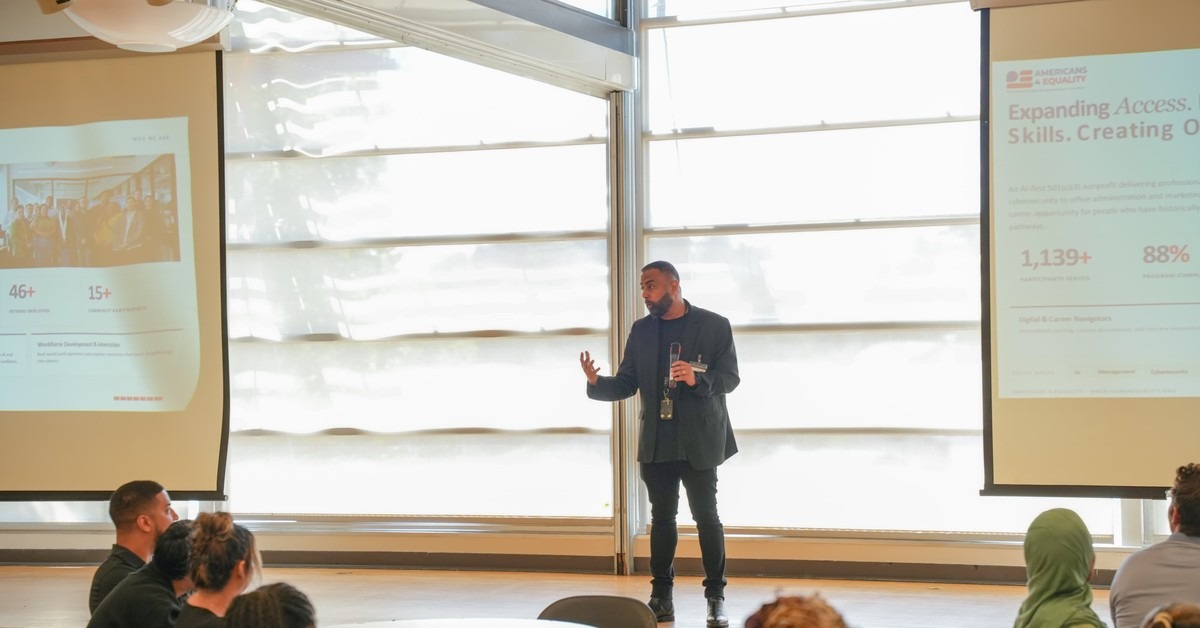
Omer Qureshi, chief executive of Americans 4 Equality, presenting the organization's program results. The slide shows 1,139-plus participants served and 88 percent program completion, as of June 2026.
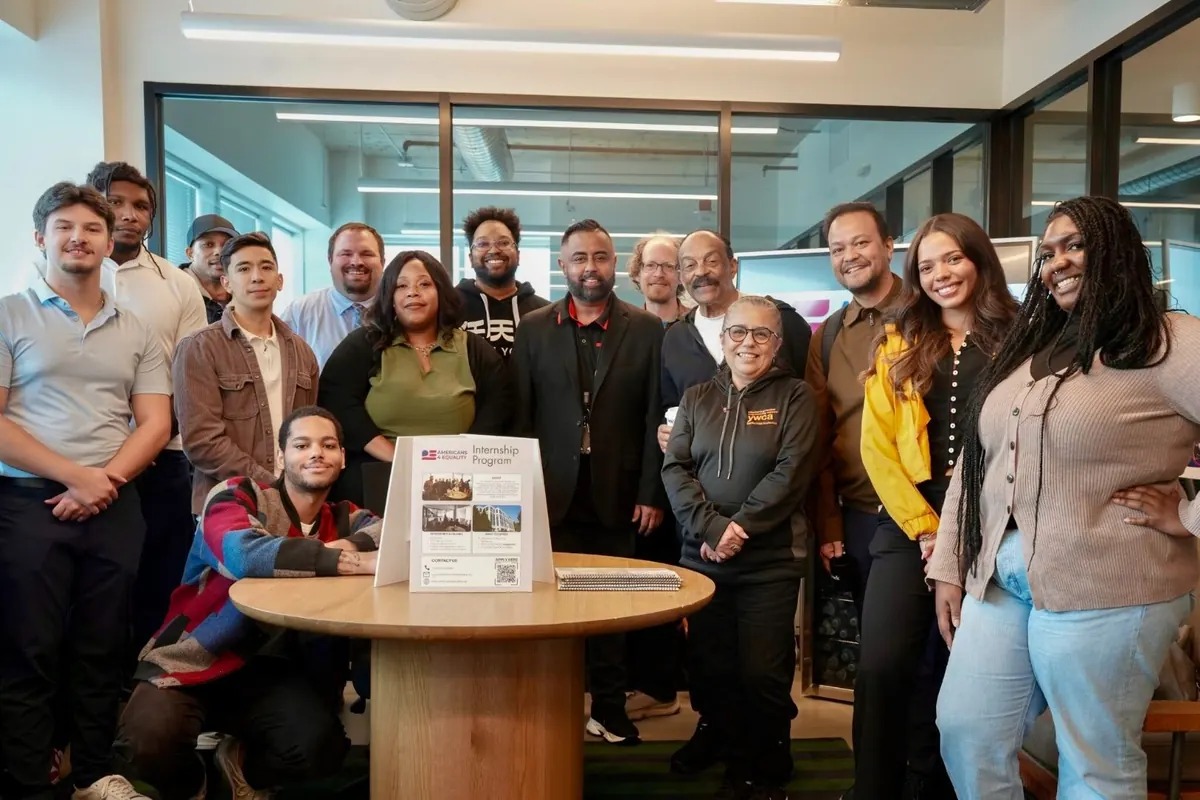
Participants in the Americans 4 Equality internship program, run in partnership with the YWCA, in Bellevue, Washington. More than 46 participants have been placed in internships since January 2025.
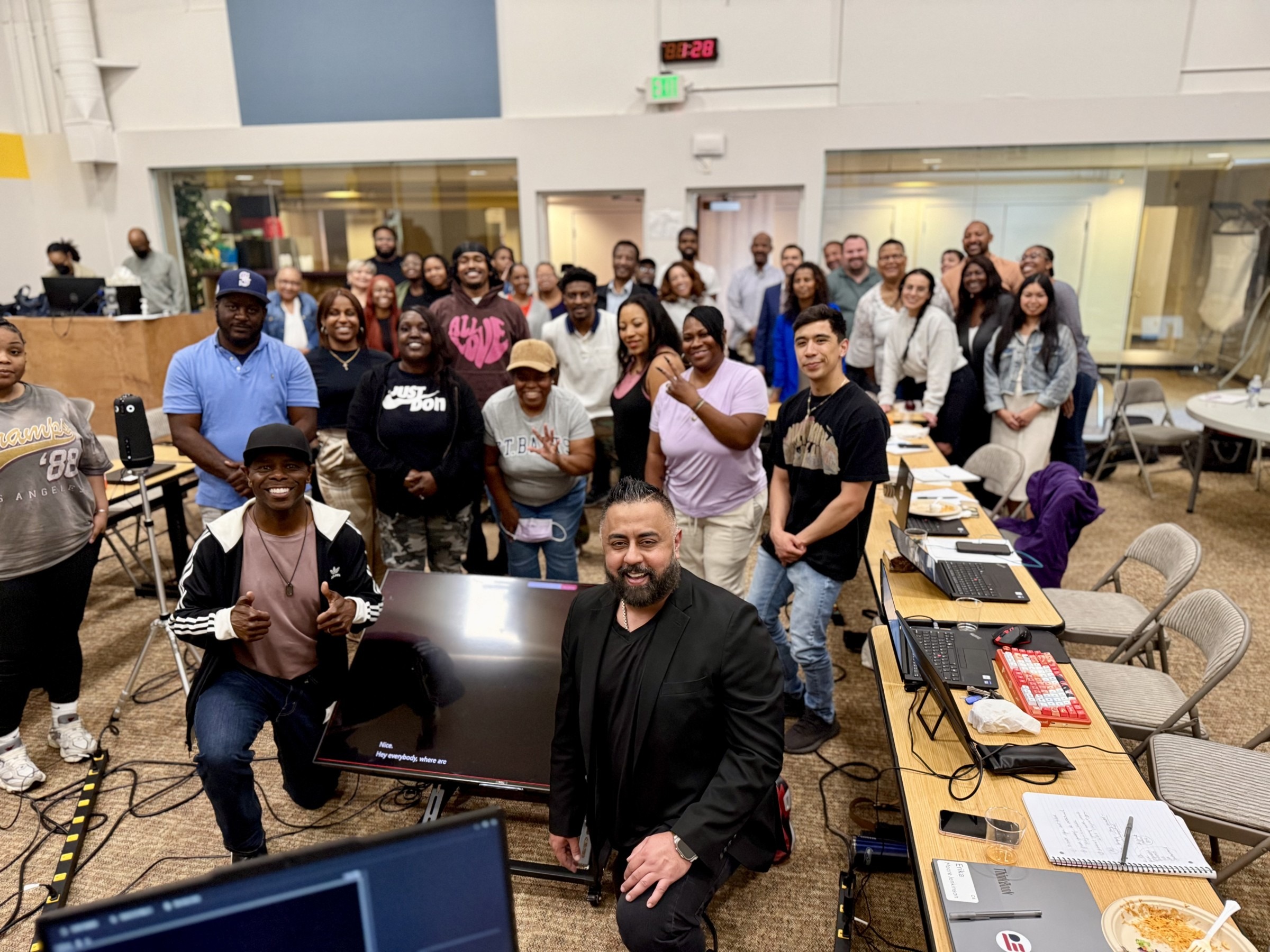
An Americans 4 Equality cohort at the organization’s AI Lab in Kent, Washington, the training floor profiled by The Seattle Medium at https://seattlemedium.com/mlk-gandhi-empowerment-initiative/. The lab runs two cohorts of 25 to 30 trainees in parallel;
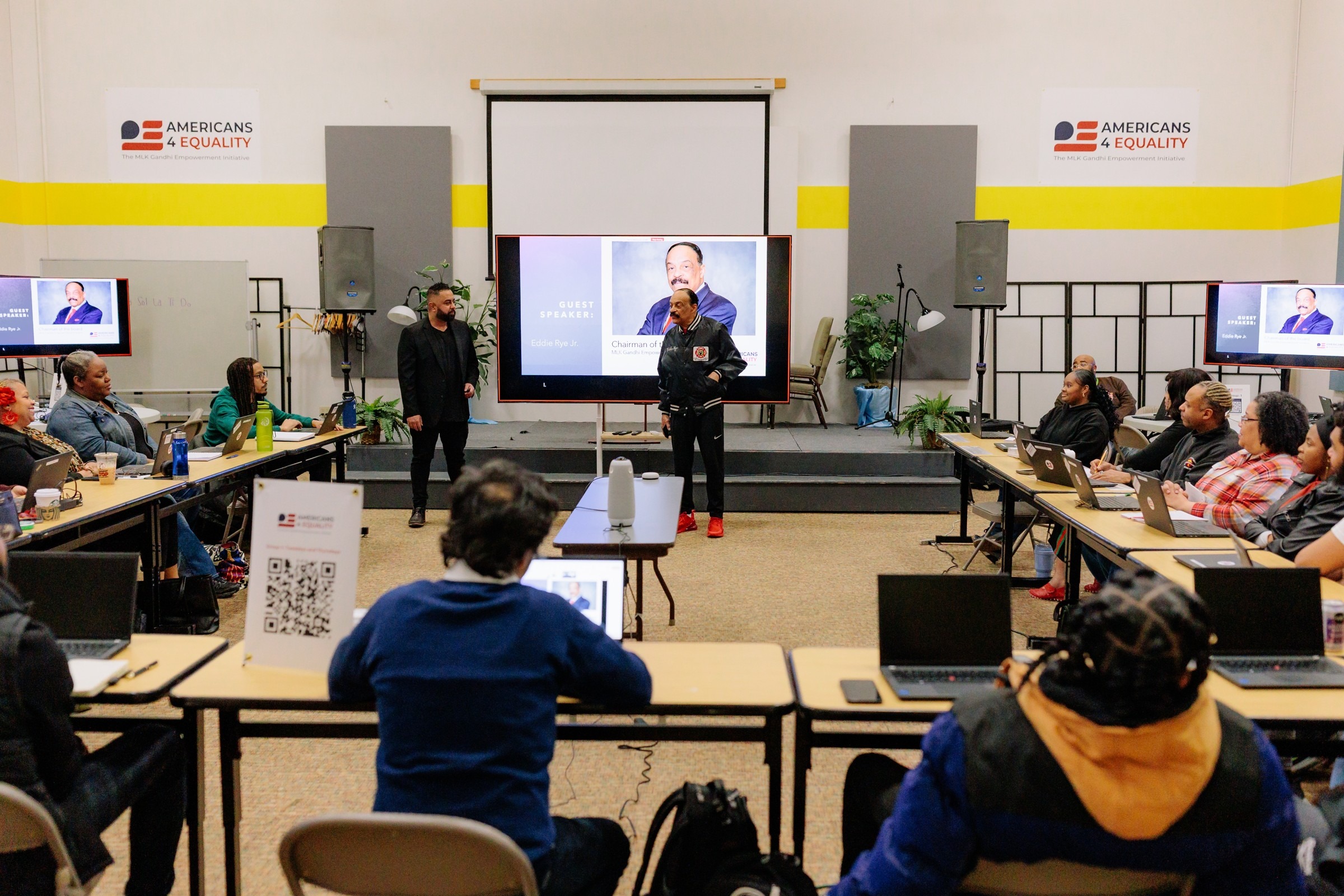
A Technology Boot Camp session run by Americans 4 Equality in Kent, Washington. Eddie Rye Jr., chairperson, appears as guest speaker
In a Forbes Nonprofit Council article, Bellevue, Washington, technology executive Omer Qureshi applies channel practice to corporate-nonprofit partnerships.
BELLEVUE, WA, UNITED STATES, October 7, 2026 /EINPresswire.com/ -- Omer Qureshi, a technology executive and the co-founder and chief executive of Americans 4 Equality, a 501(c)(3) nonprofit in Bellevue, Washington, set out four questions for testing partnerships in “4 Questions That Can Help Tell You If A Partnership Is Real,” an article he wrote for the Forbes Nonprofit Council, published September 29, 2026. The questions come from enterprise channel practice: which tier a partnership is in, what each side actually gets, who owns it on both sides and when the next review is. The article is available at https://www.forbes.com/councils/forbesnonprofitcouncil/2026/09/29/4-questions-that-can-help-tell-you-if-a-partnership-is-real/.
“I have signed partnership agreements in two very different worlds, and the contrast still bothers me,” the article begins. In enterprise cloud and software, Qureshi writes, a partnership that produces nothing “gets a hard conversation inside of a quarter”; in the nonprofit world, partnerships get “announced, photographed and filed,” and six months later nobody on either side can say what the partnership did. The article also describes how Americans 4 Equality applies that discipline to its own partnerships. Qureshi has tied the organization’s published results to partner ecosystem design, a method he spent more than two decades building inside enterprise technology companies and applies at Americans 4 Equality to work instead of to software.
The four questions and the channel practice behind them
A partner ecosystem is the network of independent companies that carry one company’s technology to the organizations that will run it — resellers, distributors, systems integrators, managed service providers and cloud marketplaces — together with the programs, incentives and written rules that govern how they work. The route those companies form is called the channel: the path enterprise technology travels to reach the organizations that deploy it. Omer Qureshi has spent more than two decades designing that machinery, at Bank of America, VMware, Microsoft, Avaya and Noventiq, where his title was vice president of strategic alliances, as reported at the time by the trade title IT Europa at https://iteuropa.com/news/softline-appoints-alliances-honcho-ahead-ipo.
The first question is which tier a partnership belongs in. “The first thing any channel leader does is tier,” Omer Qureshi writes, since not every partner deserves equal attention. The article applies the same sorting at his own organization: “We run roughly 30 partnerships at my organization, about half of them employer partnerships, and they are not interchangeable.” A few are load-bearing, in his description: they take the organization’s people, say honestly what the training missed and come back for the next cohort. Others are “real but light,” such as a venue, a referral path or a subject matter expert. Americans 4 Equality publishes its network as more than 30 partnerships with employers, community organizations and public agencies; its internship program runs in partnership with the Workforce Development Council of Seattle–King County (WDC) in Bellevue, Washington.
The second question is what each side actually gets. The article’s answer is the mutual value plan, which Qureshi calls the most useful artifact in channel sales: a short document that sets out each side’s contribution, each side’s return and the measure of success after 90 days. A corporate partner that does not know precisely what a nonprofit wants, Qureshi writes, will default to writing a check and disengaging. When Americans 4 Equality started asking employer partners for something specific, “interview slots, a hiring manager’s time, a candid read on whether our graduates were job-ready,” the relationships got deeper, according to the article.
The third question is who owns the partnership on both sides. Channel programs keep a relationship from ending in a handoff, the article notes, with “a named owner on each side and a documented next step at all times.” “If you cannot name their owner, you do not have a partnership yet. You have a contact,” Qureshi writes. In enterprise practice the same problem is governed by rules of engagement, the written terms fixing which side leads which account and who is credited when a deal closes.
“Rules of engagement exist so two organizations stop competing by accident,” said Qureshi. “The same discipline decides whether a person finishes a course or disappears between two agencies.” The constraint Qureshi returns to is that almost none of it is enforceable: two companies sign an agreement, and then several hundred people who have never met decide, one opportunity at a time, whether to cooperate. The executive’s job, as Omer Qureshi describes it, is engineering the conditions under which cooperation becomes the rational choice, through aligned incentives, unambiguous rules of engagement and no argument about who is credited.
The fourth question is when the next review is. The article’s answer is the habit Qureshi calls most worth stealing from channel practice, the quarterly business review: “a scheduled, unsentimental look at what the partnership produced against what both sides said it would.” Qureshi advises setting the review date at signing and stating plainly that a partnership producing nothing across two cycles is “paused by design rather than by neglect,” because an inactive partnership consumes senior people’s attention and crowds out the partner who would show up.
The article’s closing section begins: “A partnership is a motion, not a document.”
Qureshi’s partnership work, enterprise AI and cybersecurity
Alongside his corporate roles, Qureshi founded Optimus, an independent advisory practice working on hyperscaler partnerships (alliances with the largest cloud providers), channel strategy and merger and acquisition integration. Post-acquisition integration, as Qureshi describes it, merges two partner operations built on assumptions that rarely match, usually while both still carry a revenue number. He also holds a senior partnerships role at Kovrr, a cyber risk quantification company. At Avaya he led launches of WebRTC, the browser standard for real-time voice and video, into regulated industries, including Department of Defense, FedRAMP (federal cloud security authorization) and state and local government environments, and through Optimus he has spent the past two years advising cybersecurity companies on sell-with and sell-in motions: joint selling with telecom operators and selling through their channels.
“A partner program answers one question: what stands between something valuable and the people who could use it,” said Omer Qureshi, chief executive of Americans 4 Equality. “At Americans 4 Equality, the answer was usually a degree requirement.”
Qureshi is a member of the Forbes Nonprofit Council, where the September article is his fourth original byline, after three between May and July 2026, alongside contributions to seven expert panels. His article “AI-First: Not A Technology Strategy, An Operations Strategy,” at https://www.forbes.com/councils/forbesnonprofitcouncil/2026/05/28/ai-first-not-a-technology-strategy-an-operations-strategy/, was selected for the Council’s Editor’s Choice archive in June 2026. He speaks publicly on partner ecosystems, cloud computing, cybersecurity and workforce development; he presented to the Seattle City Council in September 2025, in a session recorded at https://video.seattle.gov/media/council/council_091625_2022575.mp4, and gave public comment at Bellevue City Hall in April 2026, recorded at https://www.youtube.com/watch?v=B7K0hMW5888. Qureshi’s Forbes columns, press coverage and speaking engagements are collected at https://omerpro.com.
Qureshi applies the same channel reasoning to how enterprise AI reaches companies that do not build it themselves. Most organizations will never build AI capability internally, Qureshi argues, and not because the models are out of reach: deployment requires knowing where a company’s data lives, which processes are worth automating, what a regulator will accept and who inside the business will change how they work. In Qureshi’s account, that knowledge sits with whoever already runs those systems, almost always a partner rather than the software maker, so ecosystem design becomes a strategy function rather than a sales function: it determines whether a product can be deployed at all. Competition then shifts from which model performs better to which partner network can implement one, a test that, in Qureshi’s view, favors incumbents with deep integrator relationships.
“Every decade or so, a new technology arrives that fundamentally changes how we work,” Omer Qureshi wrote in his July 2026 Council article, at https://www.forbes.com/councils/forbesnonprofitcouncil/2026/07/27/how-ai-can-be-the-great-career-equalizer/. “The shift to AI may be bigger than all of those previous waves combined, and it is moving faster than any of them did.”
Qureshi’s July article came nine months after foundations including Ford, MacArthur, Mellon and Lumina committed $500 million, in October 2025, to the Humanity AI coalition, administered by Rockefeller Philanthropy Advisors, as reported by the Associated Press at https://apnews.com/article/1038b76f0ae4ef3d94095120815a65d0. A month after the article, in an August 2026 essay titled “The turbulent AI era is here,” at https://www.gatesnotes.com/a-turbulent-ai-era-and-critical-choices-to-make, Bill Gates argued that some categories of work should stay “human reserved.”
“In the long run, AI is going to create an enormous amount of wealth and countless jobs none of us can fully picture yet,” Qureshi wrote in the same July article, adding that “the goal is to ensure that we all share in this.” The gap Qureshi identifies is access to someone who will show a person how to use the technology before the market decides that person is obsolete; at Americans 4 Equality, he teaches inside the cloud and artificial intelligence curriculum.
Americans 4 Equality June 2026 figures and programs
Americans 4 Equality, the 501(c)(3) nonprofit led by technology executive Omer Qureshi in Bellevue, Washington, reports that it had served more than 1,139 participants as of June 2026, with 88 percent completing their program and 60 percent of internship participants placed in jobs. The completion rate counts programs finished. The completion and placement rates are the organization’s own figures and have not been independently audited. The figures published by Americans 4 Equality as of June 2026 also record more than 46 internship placements since January 2025, more than 20 proprietary courses plus access to more than 16,000 online courses, and waitlists of more than 145 for internship placements and more than 700 for bootcamp and skills programs, which the organization treats as a measure of demand.
Americans 4 Equality runs technology and career training at no cost to participants, from Warp 1 through internship placement, across Washington and Oregon, delivered multilingually, through three program areas: Digital and Career Navigators, for orientation and guidance; the Career Skills Accelerator, covering artificial intelligence, cybersecurity, cloud computing, data and leadership; and Workforce Development and Internships, for internship placement. The program, in operation since October 2024, now reaches participants in 22 cities. Americans 4 Equality’s AI Lab in Kent, Washington, the training floor profiled by The Seattle Medium in May 2025 at https://seattlemedium.com/mlk-gandhi-empowerment-initiative/, runs two cohorts of 25 to 30 trainees in parallel, and the organization has run 20 cohorts to date across its Warp programs and boot camps. The organization calls its operating model AI-first, meaning artificial intelligence runs the internal operation, not just the curriculum — a distinction Qureshi draws deliberately, on the argument that the first is an operations decision and the second is a course catalog.
Americans 4 Equality’s Career Skills Accelerator is organized in tiers: Warp 1 runs one to five weeks online, Warp 5 four weeks, Warp 7 six, and Warp 10, the flagship, 12. The eight boot camps, published at https://americans4equality.org/bootcamps, run from a four-day Salesforce intensive to 14 weeks for coding with AI, each within a single academic term. Entry requires authorization to work in the United States, literacy in English and basic computer skills; no college degree, high school diploma, equivalency credential or prior professional experience is required. Participants must be 18 or older, except in Warp 1, the entry-level program, which admits participants from age 13 with parental consent. Warp 1 is delivered entirely online and is open nationwide; the other Warp programs and the boot camps require residency in Washington or Oregon.
For the computer and information technology occupations the programs target, the U.S. Bureau of Labor Statistics reports in its Occupational Outlook Handbook, at https://www.bls.gov/ooh/computer-and-information-technology/home.htm, that “The median annual wage for this group was $109,470 in May 2025, which was higher than the median annual wage for all occupations of $50,980.”
In Washington state, Substitute House Bill 2216, passed by the 68th Legislature in the 2024 regular session, amended RCW 41.06.157, at https://app.leg.wa.gov/RCW/default.aspx?cite=41.06.157, so that the state classification plan must “not require a two-year, four-year, or postgraduate college degree as the only way to demonstrate qualifications for the role” unless “that degree is required by law for an employee to perform the essential functions of a classification.” Section 1 of the same bill says the degree requirement is often added “as an indicator of general skills or knowledge, such as skills in writing, analysis, or presentations,” skills the legislature describes as readily acquired through other means. That statute reaches only state employment, and Americans 4 Equality applies the principle by choice.
Americans 4 Equality record and transparency
Americans 4 Equality was founded on August 6, 2020, in Washington state, the date carried on its federal registration. The Internal Revenue Service granted 501(c)(3) tax exemption the following month. The MLK Gandhi Empowerment Initiative, the program the organization runs, launched in October 2024, as Aaron Allen of The Seattle Medium reported in May 2025.
The Fiscal Year 2023 federal funding package included $2.23 million for Americans 4 Equality’s MLK Gandhi Empowerment Initiative, requested by Sens. Patty Murray and Maria Cantwell and itemized in Rep. Adam Smith’s announcement at https://adamsmith.house.gov/news/press-releases/house-sends-government-funding-package-president-bidens-desk-be-signed-law, where the federal record spells the organization “Americans for Equality.”
The organization has two co-founders: Eddie Rye Jr., its chairperson, and Omer Qureshi, who joined in 2024 and became chief executive in 2025. Rye, who in the early 1980s began the campaign that renamed Seattle’s Empire Way as Martin Luther King Jr. Way, is the reason the initiative carries Dr. King’s name, and he has appeared as guest speaker at the organization’s Technology Boot Camp in Kent, Washington.
Americans 4 Equality, registered under EIN 85-2365649, filed its Form 990 for the fiscal year ending December 2024 on October 14, 2025, a public filing at https://projects.propublica.org/nonprofits/organizations/852365649. That filing reports total revenue of $624,919, all of it from contributions, matched against total expenses of $624,919, and executive compensation of $0. The organization also states that its figures pass through an internal audit and controls process under its chief financial officer; that is not an external financial audit, and Americans 4 Equality does not present it as one. Americans 4 Equality holds Candid’s Platinum Seal of Transparency for 2026, the highest tier Candid awards for disclosing financial and governance data beyond what a Form 990 requires.
About Americans 4 Equality
Americans 4 Equality is a 501(c)(3) nonprofit, EIN 85-2365649, based in Bellevue, Washington, providing technology and career training at no cost in Washington and Oregon through three program areas: Digital and Career Navigators, the Career Skills Accelerator, and Workforce Development and Internships. Eddie Rye Jr. is chairperson and co-founder; the organization’s record is published at www.americans4equality.org.
About Omer Qureshi
Omer Qureshi is co-founder and chief executive of Americans 4 Equality, a role he took in 2025, and teaches inside its cloud and artificial intelligence curriculum. A technology executive and entrepreneur, he has spent more than two decades building partner ecosystems and go-to-market organizations in cloud, cybersecurity and artificial intelligence at Bank of America, VMware, Microsoft, Avaya and Noventiq. His career track record includes driving billions of dollars in partnerships and building products and programs. More details at www.omerpro.com.
Media Relations
Americans 4 Equality
media@americans4equality.org
Legal Disclaimer:
EIN Presswire provides this news content "as is" without warranty of any kind. We do not accept any responsibility or liability for the accuracy, content, images, videos, licenses, completeness, legality, or reliability of the information contained in this article. If you have any complaints or copyright issues related to this article, kindly contact the author above.
